Night Stalkers
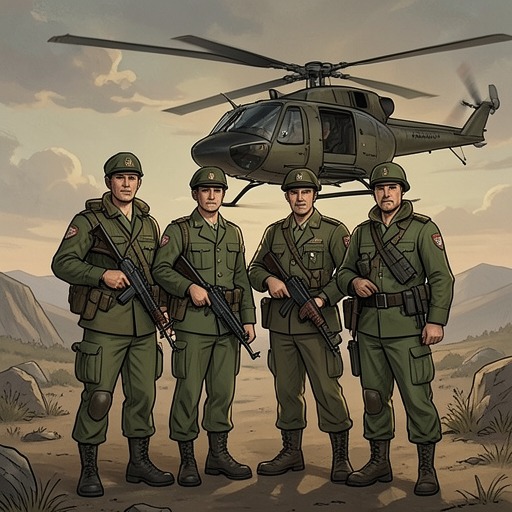
Black Hawk DownThe Night Stalkers, the secretive 160th Special Operations Aviation Regiment, are defined in the account by the demanding preparation and operational discipline of their pilots. Mike Durant’s career and the loss of Super 64 reveal both the unit’s readiness for dangerous missions and the limits of that readiness when an aircraft is badly hit over Mogadishu.
Identity and Secrecy
The Night Stalkers are identified as a special operations aviation regiment whose work was sufficiently secretive that neighbors near the unit’s base at Fort Campbell, Kentucky, often did not know what Mike Durant did for a living. His own family could be left unaware of where he was. The account presents that secrecy not as an abstract institutional trait but as a condition of family life: when Durant received his Somalia assignment, he had only two hours’ notice.
That short warning allowed him to drive home and spend fifteen minutes with his wife, Lorrie, and their baby son, Joey. He told them he would miss Joey’s first birthday, which was only three days away. The episode makes the demands of Night Stalker service tangible: a sudden operational assignment could rearrange a family’s immediate plans with almost no time to prepare.
Training and Professional Culture
Practice is described as central to the lives of Night Stalker pilots. They rehearsed everything, including what to do in a crash. Their movements through the electronic maze of the cockpit had been practiced so thoroughly that they became instinctive. The account connects this training to Durant’s calm, collected professionalism: he was a veteran of dangerous, low-flying night missions during the Persian Gulf War and the invasion of Panama.
This preparation was not a promise that a mission would go according to plan. Rather, it supplied pilots with practiced responses under pressure. When Super 64 took a powerful hit, Durant initially judged that it was still flying well enough to head back toward the airfield. The difference between training and outcome becomes stark as the aircraft’s damage worsens in flight.
Somalia Deployment and Super 64
Durant was assigned to Somalia with little warning and piloted Super 64 during the operation in Mogadishu. After the aircraft absorbed a strong impact, the air mission commander, Lt. Col. Tom Matthews, who had seen the hit from a circling command-and-control helicopter, ordered him to land. Super 64 was out of the fight. Durant turned southeast toward the American airfield, about a four-minute flight away, and noted a broad green area where he could put the helicopter down if necessary. At that point, it was still flying.
Another helicopter, Super 62, had been covering the target building and the crash site of Super 61, whose pilot was Cliff Wolcott. Its pilot, Goffena, had seen a rescue team descend to Wolcott’s aircraft and knew forces around the target building were preparing to leave. He decided to follow Super 64 at least part of the way, hoping to help Durant and the four other men aboard reach safety. After following for roughly a mile, Goffena was preparing to turn back, confident that Super 64 would make it. Then the aircraft’s tail-rotor assembly—the gearbox and part of the vertical fin—blurred and broke away.
Limits of Readiness
The Super 64 episode gives the Night Stalkers’ practiced competence a severe counterpoint. Cockpit movements might become instinctive, and a veteran pilot could calmly assess a damaged aircraft and choose a route toward the airfield, yet neither experience nor rehearsal could prevent the helicopter’s tail-rotor assembly from disintegrating. The account thus portrays the regiment through both its preparation and the danger that preparation could not remove: its pilots were trained for extraordinary conditions, but their missions remained vulnerable to sudden mechanical and combat damage.